
Phone, Fax, and Lost Orders: Why Rockland County's Manufacturers and Distributors Are Behind on B2B Ordering
B2B buyers now expect to order online without calling a rep. Here's what that shift means for the Rockland County manufacturers and distributors still running on phone, fax, and spreadsheets — and where to start.
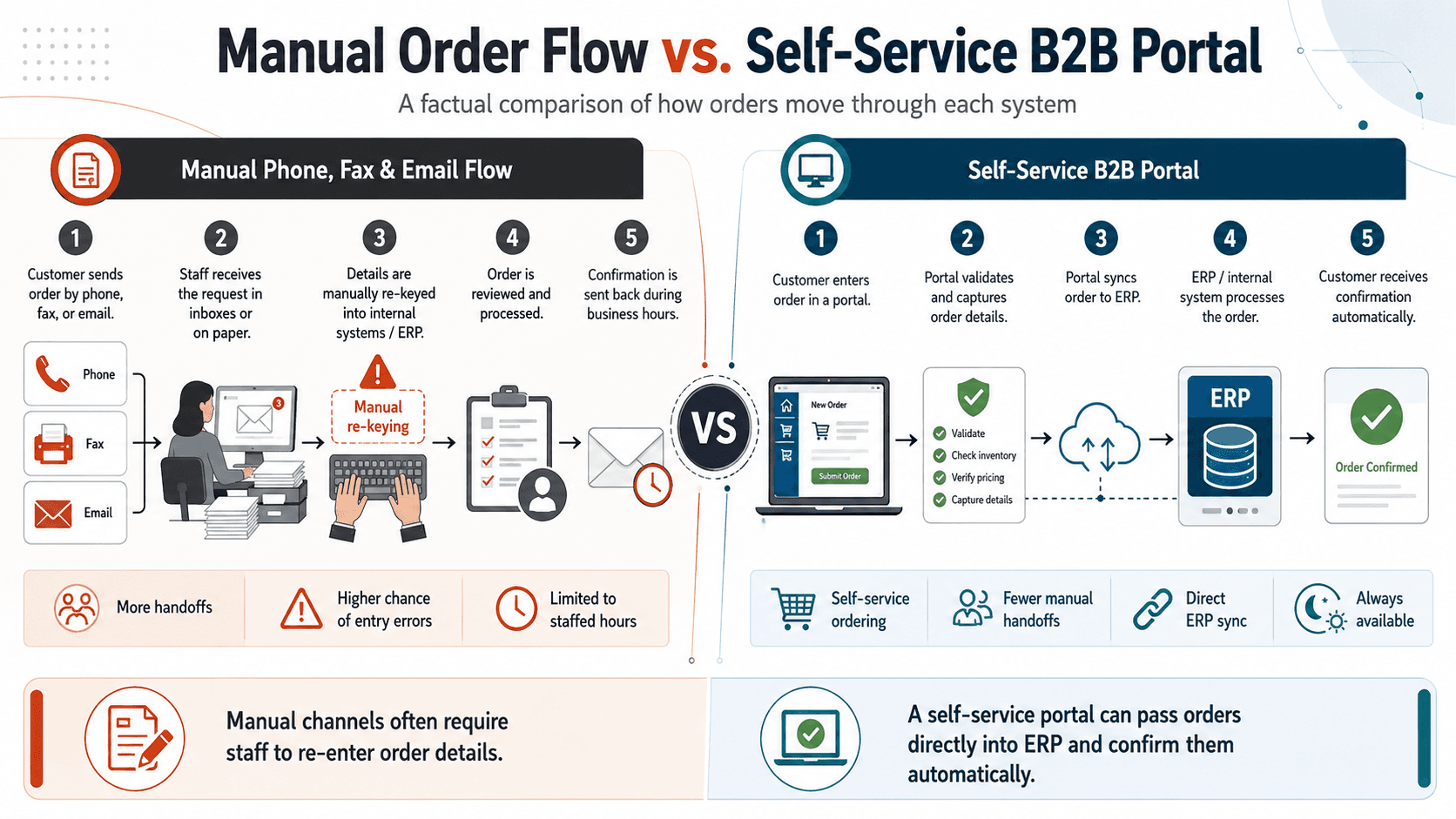
Rockland County is, quietly, a county of product companies. U.S. Census Bureau data counts 11,094 employer establishments here, plus another 33,223 nonemployer businesses — the solo operators and micro-shops that don't show up in most economic snapshots. A meaningful share of the larger ones make or move physical goods: plastics and packaging in Orangeburg and West Nyack, food and foodservice distribution in Congers, building products in Spring Valley, commercial printing in Blauvelt. And a striking number of them still take orders the same way they did twenty years ago: by phone, by fax, and by spreadsheet.
That worked for a long time. It's working a lot less well now, because the people placing the orders have changed.
Your buyers changed. Your order desk didn't.
The single biggest shift in B2B isn't a technology — it's a generational handoff in the buyer's seat. According to Digital Commerce 360, summarizing LinkedIn's 2025 B2B Buyer Report, millennials now make up about 73% of B2B buyers and 44% of final decision-makers. These are not junior staff browsing catalogs; they are the purchasing managers and owners signing off on orders, and they were shaped by Amazon, not by sales-rep relationships.
Their preference is blunt. Gartner's 2025 sales survey found that 61% of B2B buyers prefer an overall rep-free buying experience — they want to research, price, and reorder without having to call anyone. Gartner also reports that the large majority of B2B sales interactions now happen through digital channels rather than in person. When a buyer can self-serve a reorder from one supplier at 9 p.m. and has to wait for your office to open and someone to pick up the phone, the friction isn't neutral. It's a reason to switch.
What a phone-and-fax order desk actually costs
The cost rarely shows up as a single line item, which is exactly why it persists. It leaks out in pieces:
- Orders that arrive incomplete. A faxed or phoned-in order with the wrong SKU, a missing quantity, or an unclear cut spec means a callback, a delay, and sometimes a wrong shipment.
- Slow quotes. If a custom or made-to-spec quote depends on someone manually pulling numbers, the buyer who wanted an answer today goes looking elsewhere.
- After-hours demand that evaporates. Every order a buyer wanted to place outside business hours is an order your competitor's portal can capture and you can't.
- Staff time spent as a human API. Re-keying orders from voicemail, email, and fax into your system is hours a week of work that adds no value and introduces errors.
Put together, that's the classic pattern of time, trust, and money leaking out of an otherwise healthy operation — usually without anyone deciding it should.
What a modern B2B ordering setup looks like
It's worth being clear about what "online ordering" means for a B2B distributor or manufacturer, because it is not a consumer storefront. A useful B2B ordering portal handles the things wholesale actually requires:
- Account-specific pricing, so each customer sees their negotiated terms — not a public price list.
- Saved order guides and reorder history, so a repeat buyer can rebuild a standing order in seconds.
- Real-time stock and order status, so buyers stop calling to ask "is it in?" and "did it ship?"
- Quote and RFQ flows for custom or made-to-spec work, so requests arrive structured instead of as a messy voicemail.
- A connection back to the system of record — the ERP or inventory system — so the portal and the back office stay in sync.
None of this requires ripping out how the business runs. Often the bigger win sits alongside the portal in workflow automation — routing the order to the right place, triggering the confirmation, and removing the manual re-keying step entirely.
What we saw building this in the plastics and e-commerce space
We didn't arrive at this from a whitepaper. We rebuilt and modernized the e-commerce and ordering systems for Plastic-Craft Products, a West Nyack plastics manufacturer and custom fabricator — and a handful of patterns showed up that you won't find in a generic "add a store" pitch:
- Custom and cut-to-size products break standard carts. A part priced by material, dimensions, and tolerance doesn't fit a tidy SKU-and-variant model. It needs a configurator that turns a buyer's spec into a real, quotable line item — not a workaround bolted onto a consumer template.
- Reorders are the business. The majority of B2B volume is the same accounts buying the same things on a rhythm. The highest-return feature isn't product discovery; it's letting a repeat buyer rebuild a standing order from history in seconds.
- The ERP has to stay the system of record. A portal that becomes a second, conflicting source of truth for pricing and inventory just moves the manual reconciliation somewhere else. Orders, stock, and account pricing have to sync back to the system the business actually runs on.
- Shipping is its own project. Real-time freight and parcel rates, plus flat-rate logic for awkwardly shaped items, have to be designed in. Get it wrong and you either eat margin or surprise customers at checkout.
- Migration is a project, not a switch. Moving off a legacy storefront means redirects, catalog cleanup, and parity testing so you don't lose orders — or search rankings — on launch day.
You can read how we worked through all of this in the Plastic-Craft Products case study. The takeaway for any Rockland product company: this is specific, operational work, and the details are exactly where most "just put it online" projects fall down.
Where to start
Before scoping any build, answer one question honestly: how do orders come in today? If the answer is mostly phone, fax, email, and spreadsheets, the opportunity is real and measurable. From there, identify your highest-volume reorder accounts, give them a self-serve channel first, and expand — measuring time saved and errors avoided at each step. To think through what that would look like for your operation, start a conversation, or run the numbers with our cost calculator. And if getting found by new buyers is also on your list, see our companion piece on how Rockland and Westchester businesses get found online.
Sources
- Gartner, "Gartner Sales Survey Finds 61% of B2B Buyers Prefer a Rep-Free Buying Experience" (2025) — gartner.com
- Digital Commerce 360, "Why millennials continue to reshape B2B ecommerce" (2025), citing LinkedIn's 2025 B2B Buyer Report — digitalcommerce360.com
- U.S. Census Bureau, QuickFacts: Rockland County, New York (employer and nonemployer establishment counts) — census.gov
Keep Reading
Related articles
AI Automation in Rockland County: Use Cases and Benefits for Local Businesses
Website vs. Web App vs. E-Commerce Platform: What Does Your Business Actually Need?
The Hidden Cost of Manual Work for Westchester County Businesses
Not Sure Which Service You Need?
Most projects don't fit a neat box. Talk it through with someone who's built real systems.
Start a conversation