
AI for Rockland and Westchester Businesses: Where It Actually Helps (and Where It's Just Hype)
Business-AI adoption is reported anywhere from 9% to 90% depending on who's counting. Here's what the data really says, the practical work AI is good for, and a grounded way to decide where it belongs.
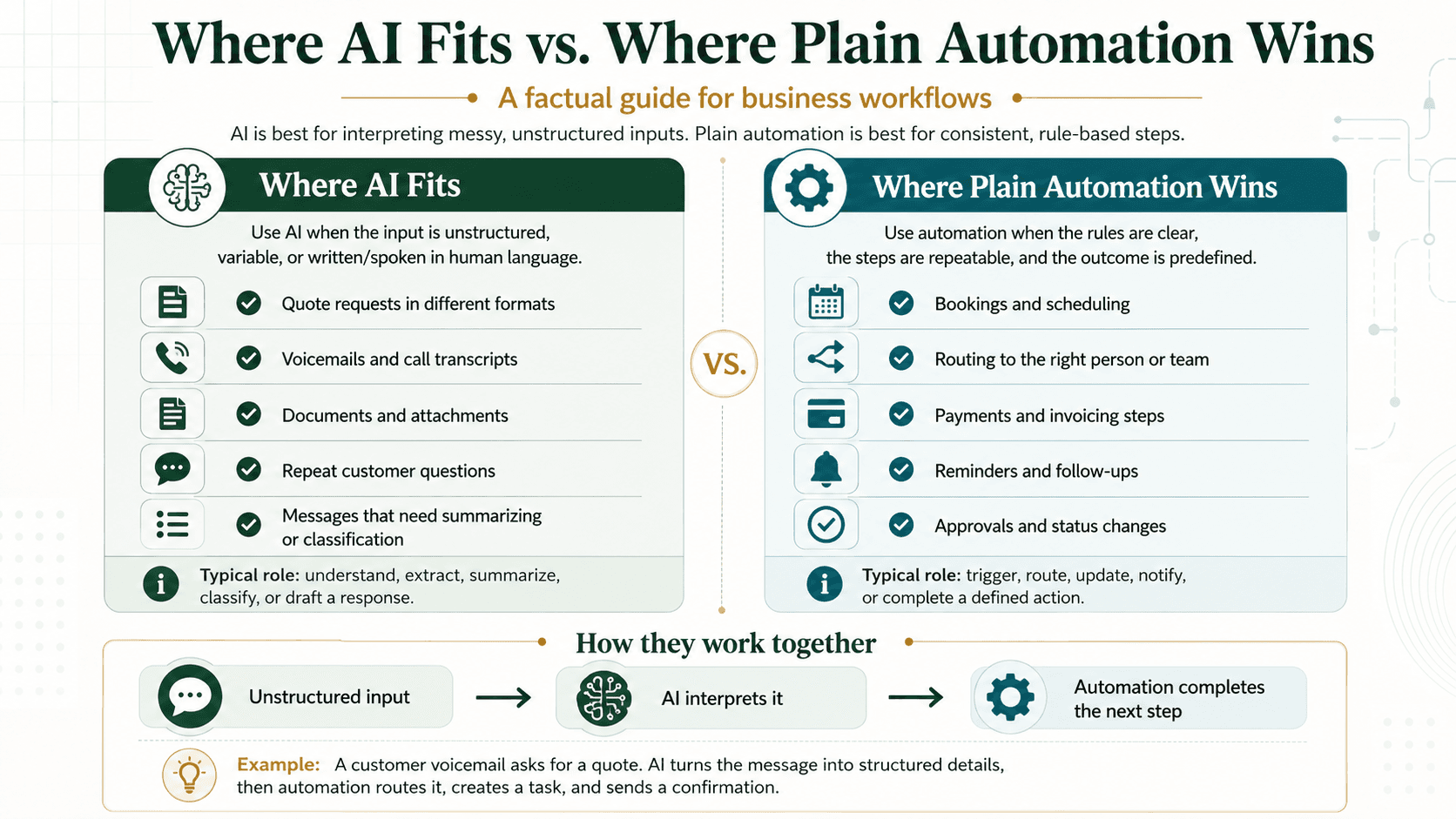
Ask how many businesses use AI and you'll get answers ranging from 9% to 90%, all from credible sources, all published in the last year. That spread isn't a contradiction — it's the most useful thing to understand before spending a dollar on AI. For business owners across Rockland and Westchester counties, the question that matters isn't whether to "do AI." It's where AI actually earns its place, and where it's a distraction from a simpler fix.
Why the numbers look so different
The gap comes down to definitions. The U.S. Census Bureau's Business Trends and Outlook Survey, which asks whether a firm uses AI in its actual business functions, put overall adoption at roughly 17% to 20% of businesses in early 2026 — and the rate climbs steeply with size, from 37% of firms with 250+ employees down to under 20% of firms with fewer than 20 employees. The U.S. Small Business Administration's Office of Advocacy, using a strict production-use definition, measured small-business AI use at about 8.8% in 2025, with the gap to large firms narrowing fast.
Meanwhile, the U.S. Chamber of Commerce reports that roughly 60% of small businesses say they use AI — more than double 2023 — and that 96% plan to adopt emerging technologies. And McKinsey's 2025 State of AI survey found nearly 9 in 10 organizations report regularly using AI somewhere. All true. They're just measuring different things: experimenting with a chatbot, versus embedding AI into how the business actually produces its work.
The real gap isn't access — it's knowing where AI fits
That same McKinsey research makes the key point: most organizations using AI haven't embedded it deeply enough to see material, bottom-line benefit. The bottleneck has shifted. It is no longer access to the tools — those are cheap and everywhere — it's clarity about which problem AI is actually solving. The businesses getting value aren't the ones using the most AI. They're the ones who picked the right place to put it.
Where AI earns its place — and where it doesn't
A practical dividing line, and the one we use: use AI where the input is messy and human-like; use ordinary coded logic where the rules are fixed. Concretely, the AI work we take on tends to look like this — each of these can be designed around approved business content, with sensible data controls and a human approval step for customer-facing or consequential output:
- Quote and RFQ parsing. Turning a rambling email or attached spec into a clean, structured brief a salesperson can quote from — instead of re-reading the same messy request three times.
- Product-data cleanup. Normalizing inconsistent catalog and spec data so an e-commerce store is searchable and accurate, rather than a graveyard of mismatched fields.
- Knowledge search. An assistant trained on your own approved content — hours, policies, product info — that answers the same repeat questions for customers or staff.
- Sales-support workflows. Summarizing calls and voicemails into CRM notes, flagging which leads need attention, and drafting first-pass follow-ups for a human to send.
- Reporting. Turning raw numbers into a plain-English summary on a schedule, so the monthly report writes its first draft itself.
AI is the wrong tool — slower, costlier, and less reliable — when a plain workflow would do: bookings, payments, routing by fixed rules, reminders, approvals, inventory flags. Reaching for AI there adds risk and expense to solve a problem that workflow automation already solves cleanly.
AI won't fix a broken workflow
This is the most important and least marketed truth in the field. If the process underneath is disorganized — scattered tools, unclear handoffs, data living in five places — layering AI on top mostly produces faster confusion. The order of operations is almost always: tighten the workflow first, then add an AI layer only where messy human language is still eating real time. Done in that order, AI becomes a genuine multiplier. Done in reverse, it becomes an expensive experiment.
A grounded starting point
For a Rockland or Westchester business, the smart first move is small and measurable: pick one repetitive, language-heavy task, decide what "good" looks like, and pilot AI on just that — with a person still in control of anything that matters. To gauge where your operation stands before investing, our AI readiness quiz is built for exactly that, and our AI integrations work always starts from a real problem, not a buzzword. When you're ready to talk specifics, get in touch.
Sources
- U.S. Census Bureau, "AI Use at U.S. Businesses," Business Trends and Outlook Survey (2026) — census.gov
- U.S. SBA Office of Advocacy, "AI in Business: Small Firms Closing In" (2025) — advocacy.sba.gov
- U.S. Chamber of Commerce, "Empowering Small Business: The Impact of Technology on U.S. Small Business" (2025) — uschamber.com
- McKinsey and Company, "The State of AI" (2025) — mckinsey.com
Related resource
Keep Reading
Related articles
AI Automation in Rockland County: Use Cases and Benefits for Local Businesses
Website vs. Web App vs. E-Commerce Platform: What Does Your Business Actually Need?
Phone, Fax, and Lost Orders: Why Rockland County's Manufacturers and Distributors Are Behind on B2B Ordering
Not Sure Which Service You Need?
Most projects don't fit a neat box. Talk it through with someone who's built real systems.
Start a conversation